The lack of a enforced and effective ratings system in Chinese media is something striking for a society usually deemed by the modern world to be conservative. While censorship is rampant in enforcing bans, especially when it comes to sexually explicit material, there are no real or imaginary distinctions between films and television appropriate for children or those that are not. News and entertainment alike attempt to be as provocative as possible, and perhaps for purposes of misguided notions of 'freedom', all are allowed and welcomed to engage with the media's messages and images.
I am often horrified at the gritty bits of Chinese movies, the depictions of severed limbs, corpses, torture... Even the fairy tale stories I had listened more closely resembled the morose themes of Hans Christian Andersen and the Brother's Grimm and not the Disney dilutions of my Western counterparts. Today's Me is impressed at Younger Me's ability to be so okay with the intense violence of those 1960s Chinese propaganda operas that I loved so much.
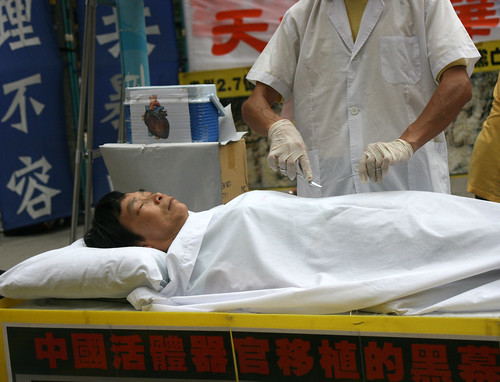
My thoughts turned the direction of these issues of tolerance and appropriateness a few days ago, after emerging from Mongkok East MTR Station in Hong Kong. In typical semi-liberal atmosphere, a group of Falun Gong supporters had set up a display on the footpath leading up to the mall. This wasn't surprising--after the Chinese ban on the Falun Gong movement in 1999 in the mainland, practitioners and sympathisers have since taken extensive measures to ensure that the rest of the world is well-informed about the Communist Party's mistreatment of Falun Gong practitioners. I remember walking past a a man lying on a hospital bed on the streets of Causeway Bay, as another in a white lab coat stood next to the bed with a set of surgical tools. Both men remained unmoving as passersby took in this representation of the CCP's alleged organ harvesting experiments on detained Falun Gong practitioners, before making them 'disappear'.
Check out this link for an image (for purposes of appropriate content on this blog, I shall not post the picture here): http://farm4.static.flickr.com/3097/2705076795_b1e7c82aa4.jpg
As desensitised as I am to Falun Gong's claims of human rights abuses, from both my academic research and interactions with people on both sides of the conflict, I was not prepared for what I saw in Mongkok that day. While most Falun Gong posterboards that I have seen in Sydney and Boston were mostly in the form of text and any images were indistinct and hard to make out, the Hong Kong branch seemed to have made the most of digital imaging technology. The first thing I was confronted with was a distinctive, A3-sized photograph (and two others taken from different angles) of a naked man lying in a foetal position after being subject to some kind of anal torture.
The second thing was the heartbreaking sight of a young girl, old enough to be just learning to read, staring intently at one of the other posterboards, trying to make out the words, while an older man stood smugly by, handing out flyers to passersby.
I have repeatedly read and heard of accounts of the plight of Falun Gong practitioners, and have lived most of my life around a community that is sympathetic to victims of the oppressive Chinese regime. But for now, let's set aside any opinions I have on human rights in China, any sympathies I may or may not have with alleged religious freedom, and ask one question: is it really necessary for a self-proclaimed peace-loving, spiritual-cultivating movement to promote their cause by forcing the general public (especially with it includes young children) to look at absolutely disgusting photographs?
I thought automatically about the images of dismembered corpses on the recent theatrical trailer for Aftershock 《唐山大地震》, the brutal crimes of passion in The Water Margin 《水浒传》and that television series about a jealous stepmother who poured boiling oil over a girl's face that I'd watched back in 1993. With some degree of bitter irony, I realised, as much as Falun Gong wants to distinguish itself from all the things that are wrong with Chinese society today, they are as much a contributor as the oppressive government that they rhetorically fight.
Because, speaking logically and as a concerned member of the community (and also as someone who may be able to make a difference in the future), Falun Gong's bombardment of the gag reflexes of the very people they are trying to get on their side is not any morally better than the alleged torture that the Communist Party practises. Call me a prude, a wimp or a counterrevolutionary, but I find it hard to support an organisation that produces badly edited and conspiracy theory-filled publications such as the Epoch Times 大纪元 and instead wants to persuade me to their cause by showing me a series of pictures that are too horrifying to see.
It is hard to find myself supporting a cause that doesn't stop young children from gaining the full access to their distressing material, perhaps in a desperate hope that converting a young girl is better than no people at all. I have no hesitation in saying that I despise this method--it reminds me, again ironically, all too vividly of the youth-recruitment during the Great Proletarian Cultural Revolution. In other words, tactics employed by the great Communist Party of China.
Responsibility and blame need to be accorded to Chinese society's lack of standards for appropriateness in public. In all fairness, if being naked in public is illegal, then so should the photographic display of a naked man being tortured (at the very least when the photographic display is not disguised as any kind of artwork). I would expect better of Hong Kong government and communities--while it is admirable that Falun Gong protesters are legally able to protest in general in Hong Kong, there is an overwhelming need for their material to have at least some social integrity and responsibility. There is rational reason, I believe, in banning some aspects of protests if the protests are out of line with societal concerns. It's not a matter of free speech or freedom of assembly or information by this point--it's simply about trying to maintain some sanity and civility.
Much of Falun Gong's struggle against its oppression has been characterised by unwanted provocation, self-delegitimising claims and social irresponsibility as highlighted in my recent experience. For one of the biggest issues in Chinese human rights in the past two decades, it's received a great deal of international and domestic attention, but the movement hasn't been able to create the huge surges of sympathy it desires.
I recognise that practitioners and supporters are angry about their plight--I just wish that they'd grow up a little about expressing it, so that I can be more supportive and less annoyed when a series of Falun Gong posterboards blocks my way down the street. For legitimacy, for sympathy and for the public's support, Falun Gong has a long way to go before it is seen as the benign spiritual movement it claims to be.